
Shares of brokerages and market infrastructure institutions (MIIs) witnessed heavy selling pressure following the Securities and Exchange Board of India's (Sebi's) pivot to a uniform fee structure, which analysts fear could dent revenues. Discount brokerages, which currently benefit from a spread between client charges and exchange fees, are expected to be most affected. Shares of Angel One, the third-largest brokerage by active clients, fell 8.7 per cent. Groww and Zerodha, the largest brokerages, are not publicly listed.

Trading in the equity market will largely depend on two major events this week - general elections result and the RBI interest rate decision - analysts said, adding that the benchmark indices may rally on Monday on exit polls' prediction of a massive win for the BJP-led NDA and strong GDP data. Exit polls on Saturday predicted that Prime Minister Narendra Modi will retain power for a third straight term, with the NDA expected to win a big majority in the polls. Counting of votes will take place on June 4.

Among the 30 Sensex companies, Larsen & Toubro, Power Grid, NTPC, State Bank of India, Reliance Industries and HDFC Bank were the biggest laggards. Sun Pharma and Nestle were the only gainers.

Industry experts believe that health insurance companies are unlikely to experience business cannibalisation due to the central government's decision to extend health coverage to people aged 70 and above, regardless of their income level, under the Ayushman Bharat scheme. On Wednesday, the Union Cabinet expanded the Ayushman Bharat Pradhan Mantri Jan Arogya Yojana (AB-PMJAY) to include all senior citizens aged 70 and older. This move is expected to benefit nearly 45 million families, comprising 60 million senior citizens, by providing Rs 5 lakh in free health insurance coverage per family.
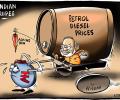
Price of international crude oil - the raw material for making petrol and diesel - dropped to a three-year low before marginally recovering but a revision in domestic petrol and diesel rates is likely only if lower rates are sustained, industry sources and officials said. Global oil benchmark Brent crude futures fell below $70 per barrel on Tuesday - the first time since December 2021 - but gained thereafter after Hurricane Francine hit crude supply in the Gulf of Mexico. Brent rose above $71 a barrel on Thursday while West Texas Intermediate advanced to trade near $68.

The combined market capitalisation of BSE-listed companies hit an all-time high of Rs 343.48 lakh crore on Monday, amid a rally in equities after the BJP registered victory in assembly polls in three Hindi heartland states. Following the sharp uptick in the market, investors became richer by over Rs 5.81 lakh crore on Monday. The 30-share BSE Sensex jumped 1,383.93 points, or 2.05 per cent, to close at a lifetime high of 68,865.12.

Invest with a 5 to 7 year horizon so that you are able to ride out price volatility and benefit from the long-term trends of demand and macroeconomic shifts.

The Reserve Bank of India's (RBI's) latest order on unsecured loans is set to hit the banking sector's growth in the near-term, cautioned analysts, as they see banks slowing down on aggressive retail lending. Besides, cost of funds for non-banking finance companies (NBFC) is expected to inch up as banks will pass on higher capital charge to NBFCs. "We believe the fallout of the RBI action will be mainly on growth, given the rising dependence on unsecured retail loans and lending to NBFCs for growth.

Most global as well as domestic brokerages are upbeat on India's largest IT services provider, Tata Consultancy Services (TCS), despite its performance during the December quarter of FY25, when it missed Street estimates. On the bourses, the TCS share price rallied as much as 6.44 per cent to hit an intraday high of Rs 4,296.80 apiece, before settling 5.67 per cent higher at Rs 4,265.55.

Even as Srini Pallia, a Wipro veteran, is set to take charge as the chief executive officer (CEO) of the company, analysts expect the stock's underperformance to continue in the near-future. This, they believe, will be on the back of likely loss of market share, and difficult business environment. "We expect Wipro to underperform peers on growth once again in FY25 as channel checks and media reports suggest Wipro is losing share with select clients across multiple verticals.

Reliance Industries may report a muted performance for the April-June quarter of FY24, with most brokerages expecting it to have witnessed a year-on-year (YoY) and quarter-on-quarter (QoQ) contraction in revenue and net profit during the period because of a poor showing by its oil-to-chemicals (O2C) division. The O2C division, which includes refining and petrochemical businesses, accounts for a little over half of RIL's revenue and profit. A muted showing by RIL in the first quarter of 2023-24 may weigh on the overall corporate earnings, as well as the equity markets.

After a sharp fall in the share prices of HDFC Bank and other private sector lenders in the past three days, the BFSI (banking, financial services and insurance) sector weighting in the Nifty50 has slipped to a seven-year low of 32.03 per cent, down from nearly 36.6 per cent at the end of March 2023 and 34.5 per cent at the end of December 2023.

The three day MPC meeting began on Monday and the decision will be announced on Wednesday by RBI Governor Shaktikanta Das.

The queue for mutual fund (MF) licences has thinned down due to quick clearances by the Securities and Exchange Board of India (Sebi) alongside applications being withdrawn amid regulatory changes. There were, at the end of September, only two pending MF applications: By AngelOne and Unifi Capital. By comparison, there were 11 applications lying before the market regulator at the start of calendar year 2023.

'Many do not have robust business models, and their prospects of survival and long-term growth are poor.'

Investors shunned shares of oil marketing companies (OMCs) on Friday as they feared that the government's decision to cut retail prices of petrol and diesel could hurt the companies' profit margins in the near term. On Thursday, the government announced that OMCs will reduce pump prices of petrol and diesel after a record 22 months, making them cheaper by Rs 2 per litre in the national capital. The changes were effective from Friday.

A combination of factors, including heavy investments in US Treasury bonds and dollar sales at a healthy profit, facilitated the Indian central bank in transferring a record surplus of Rs 2.11 trillion to the government for 2023-24 (FY24). The RBI's dollar purchases increased in FY24, supported by robust capital inflows endorsing the economy's health.

Domestic quarterly earnings, global trends and foreign fund trading activity would dictate the movement in equity markets, which may face volatility amid the scheduled monthly derivatives expiry this week, analysts said. Equity markets took a breather last week. The BSE Sensex declined 298.22 points or 0.48 per cent and the Nifty dipped 111.4 points or 0.60 per cent.

International oil prices continue to be extremely volatile, falling on one day and rising thereafter, a top oil ministry official said explaining the reason behind no reduction in petrol and diesel prices despite softening in input cost, but could not say if the rates will be cut before Maharashtra elections. Global oil benchmark Brent crude futures fell below $70 per barrel last week -- the first time since December 2021 -- but gained thereafter. Brent was trading at $74.58 per barrel on Thursday while West Texas Intermediate advanced to trade at $71.71.

It's not only the Indian markets that command a valuation premium over their global peers; shares of subsidiaries of India-listed multinational companies (MNCs) also trade at rich valuations compared to their parent companies. An analysis of 12-month forward price-to-earnings (P/E) and price-to-book (P/B) multiples of domestically listed MNCs shows that most quotes have a premium ranging from 2.1x to 6x that of their parent. Similarly, P/B, in most cases, is significantly higher in the domestic market.

Will Infy spring a surprise in subdued second quarter?

The S&P BSE Sensex and the Nifty50 have hit record highs amid the poll outcome-triggered bull frenzy at the bourses. Most analysts feel that the indices are on course to rise further over the next few months - till the general elections - albeit amid intermittent corrections - largely triggered by global developments. Bharatiya Janata Party's (BJP's) win in the three state elections of Madhya Pradesh (MP), Rajasthan and Chhattisgarh, analysts at Jefferies believe, reinforces the consensus expectations of a Modi win 2024 national elections with a greater likelihood of over 300 seats for the BJP.

Accenture's Q1 FY22 results have sent a wave of cheer among analysts, as the company raised its revenue guidance and said it expects double-digit growth in outsourcing, up from single digit to low double-digit growth expected earlier. Accenture's financial year ends on August 31. The company raised its revenue outlook for FY22 to 19-22 per cent in local currency, up from 12-15 per cent earlier.

Last month, the National Stock Exchange witnessed 'flash crash', when the Mumbai-based brokerage Emkay Global Financial Services sent the exchange index tumbling as much as 15.5 per cent in just a few seconds, creating a panic among traders.

As temperatures soar across the country, amid searing heat wave, analysts see power demand hitting fresh record highs this year. The time, therefore, may be opportune to add related stocks on dips as higher demand boosts earnings visibility, they said. On April 18, India's electricity demand touched a new high of 216 gigawatts.

'Younger investors start their journey with very little capital so they are risking less while they have a lot of time to experiment and learn early on.'
Shares of Motilal Oswal Financial Services, Edelweiss Financial Services and IIFL Holdings have all doubled in the past one year against the Sensex's 23 per cent gain.

The rally in PSBs, analysts feel, was more a knee-jerk reaction to the development, and the actual benefits will start to accrue once the addition takes place in 2024. "The actual benefit for banks from the inclusion in JP Morgan's EM Index will accrue from June 2024 onwards. "Until then, the larger fundamentals of the market will dictate the moves. "Once the initial euphoria subsides, bond markets will look to global cues which may trigger fresh selling," said Siddharth Khemka, head of retail research, Motilal Oswal Financial Services.
Shares of ICICI Bank may outperform those of HDFC Bank in the near-term, analysts said recently, after the Sandeep Bakhshi-led private sector lender reported a strong set of numbers for the July to September quarter (Q2) of financial year 2023-24 (FY24). The result, they said, reiterated that ICICI Bank is maintaining a sustainable and prudent growth led by tech-driven initiatives as against HDFC Bank, which is facing merger related challenges. According to analysts at Prabhudas Lilladher, ICICI Bank is valued at par with HDFC Bank at 2.2x/1.9x on FY25/26E core adjusted book value (ABV) basis.

Tech Mahindra was the top gainer in the Sensex pack, rising over 2 per cent, followed by HCL Tech, Infosys, L&T, Tata Steel and ITC. NSE Nifty advanced 41.60 points to 15,853.95.

Despite the best ever quarterly net profit of Rs 3,091 crore during April-June of financial year 2023-24 (Q1FY24), challenges are mounting for InterGlobe Aviation-run IndiGo in the near term, said analysts. Given this, most brokerages have retained their ratings from 'buy to underperform', as well as their target price for the stock. For instance, Motilal Oswal Financial Services has retained its 'neutral' rating on the scrip as it believes the low-cost airline is facing teething issues at present.

Mumbai Metropolitan Region recorded housing sales of nearly 9,200 units in Q3 of calender 2020, against 3,620 units in the preceding quarter, registering a 1.5 times growth which is the highest growth seen any city except Chennai.

Even as the near-term outlook for the quick service restaurant (QSR) industry remains muted, brokerages are positive about the prospects of Sapphire Foods India. Their preference for the QSR chain comes on the back of the steady performance of Kentucky Fried Chicken (KFC), superior execution and reasonable valuations. The Sapphire Foods stock is up 11 per cent since the start of November.

Benchmark indices bounced back on Wednesday after falling for five straight sessions, with investors snapping up the recently-mauled IT, finance and consumption stocks amid a supportive trend overseas. A rebounding rupee further bolstered sentiment, traders said. Halting its five-session slide, the BSE Sensex jumped 574.35 points or 1.02 per cent to finish at 57,037.50. Similarly, the NSE Nifty surged 177.90 points or 1.05 per cent to 17,136.55.

Use the opportunity to increase equity exposure because these are short-term blips.

The decline is attributed to lower salary growth and a rise in households' financial liabilities.

Dhananjay Sinha, co-head, institutional research, Emkay Global Financial Services tells Business Standard in an interview that even as global commodity prices have softened in response to expectations of weaker global demand, the stronger performance of equities is seemingly pre-empting stronger growth.

Strong macroeconomic headwinds causing turbulence in the $245-billion Indian IT industry are yet to calm down. Top Indian IT services companies are likely to post a decline or just marginal growth in sequential revenue in Q1FY24 because of a soft discretionary spending environment. Though the first quarter is seasonally strong for IT firms, "June 2023 will be an exception", according to analysts at Kotak Institutional Equities.
With the Big Four information technology services players having disappointed the Street, the focus is on mid-cap IT players who seem to have met expectations, according to analyst reports and management commentary on the demand environment.
Invest 10 per cent of investment portfolio in consumer-based, largecap stocks, say analysts.
 © 2026 Rediff.com - Advertise with us - Disclaimer - Privacy Policy - Sitemap - Feedback - About us - Terms of use - Grievances